Welcome to the second edition of our annual Black Friday Cyber Monday Trends Report. As we did last year, we conducted a comprehensive survey in July 2025 to explore strategies, challenges, and expectations for the upcoming peak season among merchants and agencies.
The findings reveal how businesses plan to capitalize on the season and what new tactics they intend to implement. This post is a summary of our report findings, and you can refer to our strategies guide to prepare for your best BFCM yet.
In 2025, the emphasis on site performance and optimization more than doubled, highlighting a focus on customer experience and minimizing friction to boost profits. In 2024, only 13% of survey respondents prioritized website optimization—this number increased to 33.4% this year.
Merchants’ promotional strategies are also evolving. In 2024, new products, special discounts, and targeted marketing strategies were the focus. In 2025, the emphasis is on subscriptions and product bundles, with many stores offering tiered discounts and new subscription models for more accessible gifting.
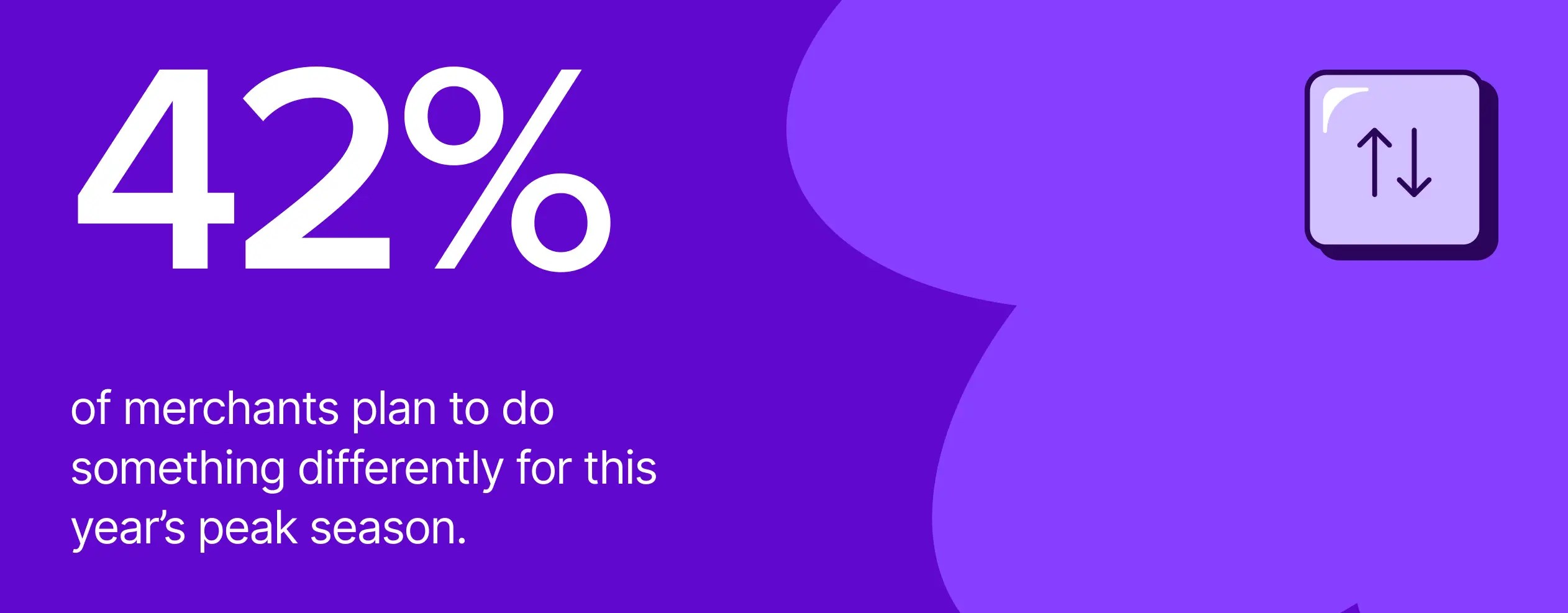
This year, 42% of merchants are changing their approach to BFCM. They’re thinking creatively and plan to:
-
Introduce or update a subscription service (30%): Some merchants noted new subscription plans, new memberships, and updated options for their existing subscribers.
-
Try new promotional strategies (25%): Many new promo strategies are on the horizon for our merchants this year, including new and sale-specific product bundles, earlier sales, strategic email list-building, enhanced social presence, and brand partnerships.
-
Update their infrastructure (12%): Others noted launching an updated website before the busy period—a significant project that will likely pay off. Hosting upgrades were another popular choice.
These strategies indicate a broader effort to enhance the customer experience and the offers that attract them. To make these decisions, businesses are considering historical sales data (29.8%), their marketing budgets (22.4%), and industry trends (19.4%).
Larger businesses start their planning earlier
Among merchants who experience a seasonal lift during the holiday season, 36.4% plan one to four weeks ahead, and 30.9% plan one to three months ahead. The remaining stores are split between no preparation at all (20.6%) and more than three months of preparation (12.1%).
These numbers shift as businesses grow larger: Of stores making more than a million in annual revenue, 37.5% start their holiday planning one to three months in advance, and another 25% start planning more than three months ahead.
Businesses under a million in annual revenue typically take less time in the lead-up. Of those stores, 22.2% prepare one to three months out, and only 7.9% prepare more than three months ahead of BFCM.
As I’ve seen from my own holiday receipts, Black Friday Cyber Monday is a significant revenue driver for ecommerce businesses. In 2024, Black Friday alone generated $10.8B in revenue, up from $9.8B in 2023. Cyber Monday saw a similar increase as consumers spent $13.3B in ‘24—up from $12.4B in ‘23.
Overall, the holiday season (from November 1 to December 31) generated $241.4B in 2024, nearly $20B more than in 2023.
The peak season can be a make-or-break time, but this is shifting for many merchants. Last year, 66% of stores saw a spike in sales from October to December, nine points higher than this year’s 57%. This could indicate that businesses are ramping up promotional efforts throughout the year to reduce reliance on BFCM.
That said, the holiday season still represents a major bump in many merchants’ revenue schedules, with 73% of merchants reporting that this period accounts for over 20% of their annual revenue. This is consistent with the 72% of merchants who reported the same in 2024.
Of that group, 28% reported that BFCM and the holidays account for 30 to 50% of annual revenue, and 8% of merchants attribute over 50% of revenue to the peak season.
In 2025, 33.4% of merchants said that website performance optimization was their top preparation strategy for the holiday peak season. An additional 7.5% will upgrade hosting, which will also improve site performance.
After performance optimization, increasing inventory was the second most popular priority, with 32.6% of merchants ranking it as first on the list. Businesses also aim to keep the customer experience streamlined with express checkout and buy now, pay later (BNPL) options. Nearly half (49.8%) of respondents across the board offer express checkout, but businesses over $1M in annual revenue were three to four times more likely to offer BNPL than those under a million.
Marketing